
In October 2019, the innovative start-up D.E.E.P. LAB. Srl was initiated after winning funding by the PIN call of the Apulia region. Its sector is education and cultural entertainment realised with the support of advanced technologies, such as 3D printing, which stimulates multi-sensory learning. The project with which the start-up won the PIN competition is 3D City P.L.U.S. Play with Land and Urban Scraps # Bari v. 1.0, a board game focusing on the history and urban evolution of the city of Bari from the Byzantine era to the contemporary age. The project aims to induce reasoning about how urban centres expanded in response to the thrust of macro-history, following the changes of the territory over the centuries, the major events of the past and the historical protagonists. The innovative start-up D.E.E.P. LAB bets on the virtuous link between history, territory and technology to enhance the relationship between places and 3D printing through the survey, prototyping and elaboration of three-dimensional historical centres to be used as support for games and laboratory educational activities.
Challenge overview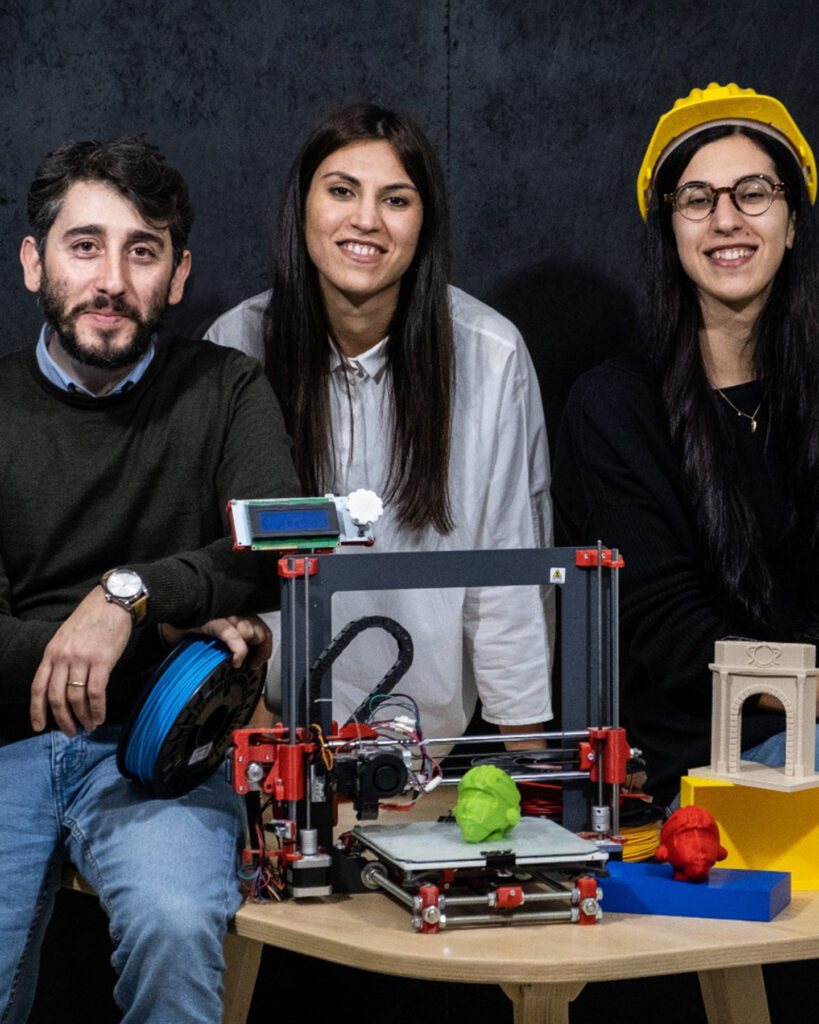
It was particularly challenging to cope with the start of the pandemic for a start-up whose main objective was to work with schools and museums. Developing the prototype of the 3D City P.L.U.S. was also a big challenge. The team had to face the closures of libraries and cultural venues, which hampered the study and research phase, as well as the product testing phase. However, they took the difficulty as a stimulus to reflect on the need to take a further step forward, i.e. to make the dematerialisation of the cultural and educational experience possible by starting to develop ideas for remote use.
Establishment of the organisation/initiative/enterprise
The team of D.E.E.P. LAB. Srl is composed of three members: Domenico Ruggiero, surveyor and 3D maker, specialised in digital manufacturing; Federica Fiorio, an architect specialised in architectural and landscape heritage; and Antonella Fiorio, contemporary historian, PhD student in Human Relations Sciences at the University of Bari, passionate about playful and experiential didactics. Three different professional spheres perfectly complement each other in the start-up and guarantee carefully designed products from a technological, artistic, historical and didactic point of view. In particular, in the realisation of the 3D CITY P.L.U.S., Domenico is in charge of the survey, prototyping and modelling of the historic centres in 3D. Federica studies the territory from a physical and architectural point of view, acting as a link between the three-dimensional rendering and the historical-artistic coherence. Antonella developed the didactic workshop focused on the history of places having the 3D model as its tool.
Management structure and governance
The company is for-profit with three managing partners. The business model is doubled – oriented to business partners and individuals. B2B for cultural institutes and biblio-museum centres, which buy the product and offer it to the final beneficiaries through chosen activities, to be carried out autonomously or with the support of the D.E.E.P. LAB team. On the other side, the B2C model aims at private individuals, and gaming and board game enthusiasts who can purchase the product for enjoyment and personal use.
Principles of work, objectives and activities
The guiding principle of the activity is the philosophy of Edutainment, which reconciles learning needs with a communication system focused on fun, emotion and entertainment in which playing becomes an educational tool. The focus is not only on tangible and intangible aspects but on the important role of innovation as a bridge between tradition and new technologies. ICT tools can thus become dominant means capable of triggering creative processes.
Target groups
Educational institutions, public and private bodies dedicated to culture and tourism, and biblio-museum centres represent the target groups for the product. Their dissemination and utilisation actions spill over to the final beneficiaries, i.e. students and teachers, citizens, tourists, and gaming enthusiasts, united by a constant search for engaging activities that respond to varied interests, stimulate cooperation and make their connection with the places around them.
Innovation
Places of culture need to be more attractive to new generations of users, who increasingly demand immersive experiences in the sense of edutainment. Both didactics and experiential tourism are emerging, and the 3D CITY P.L.U.S. project looks at both aspects. Biblio-museum centres need tools and support that encourage users to visit their spaces in an active and lasting way, to offer content specifically designed to encourage participation and reflection on the places they live in or pass through. The start-up D.E.E.P. LAB hopes to meet these needs, grasping the impulses coming from modernity. From a technological point of view, the technology used for the realisation of the prototype of the 3D CITY P.L.U.S. is 3D printing carried out with bioplastic material, PLA, which through the variability of colours and final rendering effects guarantees an easy multisensory, dynamic and immediate approach to the final product that can be customised. The 3D CITY P.L.U.S. can be used with perfect autonomy by cultural institutions, as the boxed game contains everything necessary to carry out the in-depth workshops or request the support of the D.E.E.P. LAB team as trainers.
Key partners
The partners of D.E.E.P. LAB. are the Department of Humanistic Studies and the Chair of Didactics of History of the University of Bari. They guarantee methodological support in the study and testing activities of the laboratories. The Historia Ludens Association has been working for years in playful didactics and certifies the pedagogical validity of the products. The Digital Fabrication Centre (FabLab) of the Bari Polytechnic University provides workspaces and technical expertise. Each partner contributes to spreading the brand to the wider market.
Impact and Evaluation
As it is still an experimental project, there is no data on the impact of the project and the activity among the identified target groups. The team has contacted schools, teachers and headmasters, who have enthusiastically welcomed the proposals, but there have not been concrete tests conducted at cultural institutions. However, positively report the collaboration with the FabLab Bitonto and ULab association. With them, the team conducted coding workshops for children, which were a great success among the participants. In addition, the partnership with the Department of Humanistic Studies of the University of Bari ‘Aldo Moro’ was renewed in the new Department of Humanistic Research and Innovation (also UniBa), with which the team collaborates on teaching and training activities.
Recommendations
The best practice is practically valued because it combines cultural heritage with contemporary technologies. The gained knowledge can be transferred to other cities and regions in the promotion of historic periods and events.
Lessons Learned
Growing a business requires a constant full-time commitment of the members and above all reliance on experts for promotion and communication activities.
References

Funded by the European Union. Views and opinions expressed are however those of the author(s) only and do not necessarily reflect those of the European Union or the European Commission. Neither the European Union nor the granting authority can be held responsible for them.