
Brief description of the organisation/initiative
Coltipack is a project focused on the primary packaging of tablets, a very common technology product for both adults and children. Once the tablet is taken out, the packaging, made of certified FSC cardboard and without the use of adhesives, provides a playful and educational experience: the biodegradable inner filler consists of a peat mat on which assorted microgreens seeds can be directly grown. These are very easy-to-grow indoor seedlings with interesting nutritional properties that grow easily in just one month, thus without affecting the original packaging. Thanks to pre-drilled cards, one can access informative content about the seedlings.
Challenge overview
The primary packaging of electrical and electronic equipment is usually made of materials, specifically internal fillers. This packaging model is not sustainable as it uses materials such as polystyrene or expanded polystyrene. Therefore, Coltipack chose to go beyond the materials usually used for this type of product, choosing biodegradable and compostable ones. Furthermore, primary packaging understood as an object in itself is generally stored in the attic where it remains, taking up space. Therefore, following the circular economy principles, the team wanted to design packaging that would go beyond a single purpose.
The idea was born during the Covid-19 pandemic when the abuse of plastic and plastic wrappings grew exponentially. The recent Covid-19 pandemic has led to an increased demand for single-use plastic, intensifying pressure on this already out-of-control problem.
In addition to regular packaging, an additional layer is added to the product, and more plastic packaging is created, only to be immediately thrown out. Their idea was to generate new sustainable packaging ideas and counteract the abuse of plastic that the pandemic has generated.
Establishment of the organisation/initiative/enterprise
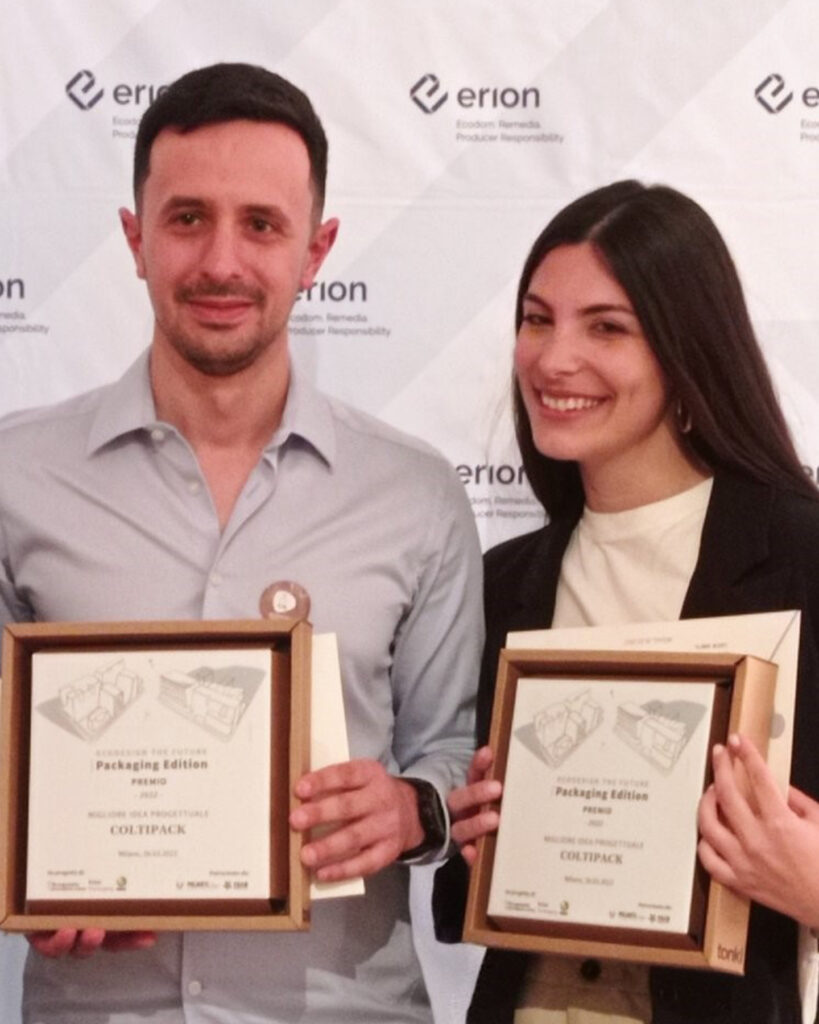
A group of young people created the project Coltipack by using their inspiration and experience. The award did not result in the establishment of a company.
Management structure and governance
It is a non-formal group, which promoted the project in Eco Design. Three people with complementary skills form the group. To date, they do not have a business structure. They decided to remain a group of co-workers.
Specifically, the group is formed by
- Annachiara De Marco, graduated in Industrial Design from the Polytechnic University of Bari
- Sara Gransinigh, degree in Chemistry, Low Carbon Technologies and Sustainable Chemistry from Alma mater studiorum at the University of Bologna
- Fabrizio Virga, graduated in Circular Economy from the University of Tuscia in Viterbo
Principles of work, objectives and activities
The objective of Coltipack is to promote the general Circular economy and, in detail, sustainable packaging.
This concept is the heart of its approach of Coltipack to sustainable packaging. The ideators also state that all its packaging is created using the least possible amount of material and the most sustainable materials. Coltipack’s new strategic framework for sustainable packaging reflects the three key stages of a circular value chain: Materials from sustainable sources, Intelligent packaging design and closing the loop.
Target groups
Indeed, the project stimulates both the curiosity of an adult audience and the manual dexterity of children. Thanks in part to the use of cardboard tools made from the packaging itself.
Innovation
The experiences associated with Coltipack make it possible to go beyond the concept of a ‘tablet’, understood as an electronic object aimed primarily at individual use. Furthermore, each step is accompanied by digital interaction with an app: QR codes provide additional information about the seedlings, and it is possible to compare growth with pictures and other indications in the app.
Key partners
The project was awarded in the initiative called Ecodesign for future. Key partner of the project is Economia Circolare.com, a magazine dedicated to the circular economy.
Impact and Evaluation
Economia Circulare.com recognised the importance of Coltipack: the packaging that turns into a “micro garden” and awarded it as circular economy initiative.
Recommendations
Governments and institutions should invest both in research to find innovative solutions to utilise production waste, but also in educating citizens to promote the circular economy.
This extends the life cycle of products and helps to minimize waste.
Lessons Learned
The project shows that the circular economy is possible and must be the solution for a sustainable planet. By investing in research, it is possible to find sustainable solutions to everyday problems, such as the use of a package
References
Coltipack in Economia Circolare.com

Funded by the European Union. Views and opinions expressed are however those of the author(s) only and do not necessarily reflect those of the European Union or the European Commission. Neither the European Union nor the granting authority can be held responsible for them.